
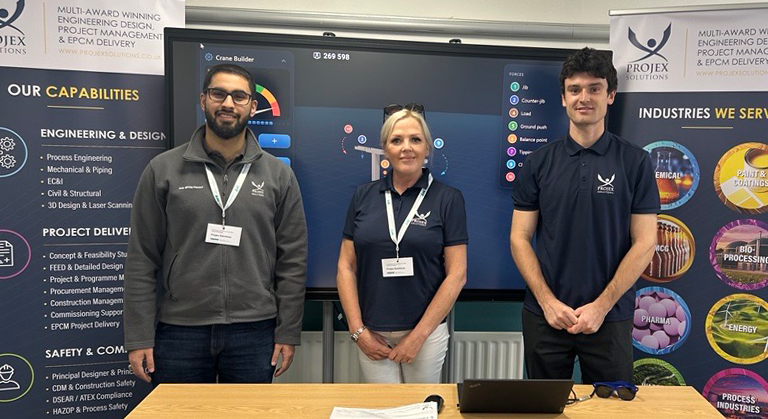

Around 600 students attended the West Yorkshire Manufacturing Services on National Manufacturing Day, arriving by the coachload from schools across West Yorkshire. Sharon Craven, Finley Cahill and Hayder Abbas were there representing Projex Solutions, and between them they spoke to as many of those students as a single stand possibly could.
One thought kept coming back to all three of them through the day. Every engineer in our business was once standing exactly where those students were standing: fifteen or sixteen years old, no real idea what engineering looked like as a job, and with nobody obvious to ask.
Nobody is born knowing what an engineer does
Ask a room of teenagers what an engineer is and you will get various answers involving hard hats, and car engines and bridges and so on. All true, but all still a long way from the whole picture.
Very few people arrive at a career in engineering by plan. They arrive because somebody showed them it existed. A relative who worked at a plant, a teacher who pushed them towards maths and chemistry, a factory tour that stuck in the memory. One conversation, at the right age, is often what really matters.
That is what a day like National Manufacturing Day is really for. Not recruitment, and not marketing. It is 600 young people getting to ask questions they would otherwise never get the chance to ask, of people who are doing the job.
There is more than one way in
The question our team were asked most often was about apprenticeships. Older students in particular wanted to know whether there was a route into engineering that was not three years at university, and whether anyone would take them on at eighteen.
The honest answer is yes, and we think it is worth saying loudly. Engineering is one of the few professions where the degree route and the apprenticeship route both lead somewhere genuinely good. Some of the best engineers any of us have worked with came up through an apprenticeship, learned on a live plant, and studied alongside it. Others took A-levels, went to university and came in as graduates. The industry needs both, and a fifteen-year-old who is good with their hands and good at maths should know that nobody is going to hold the route against them.
The second most common question was simply: what do you actually do all day? Which is a fair question, and a harder one than it sounds.
Harder than ChemUK, and more worthwhile
Hayder covered the afternoon shift and made a point that stayed with us. He has stood on a Projex stand at ChemUK, talking to professionals and delegates all day, and yet he found talking to students far more difficult.
At ChemUK everyone in the hall already knows what process engineering is. You can start halfway through the conversation. A fourteen-year-old gives you no such head start, and they will not politely nod along if you lose them. You have about three minutes, and you have to be genuinely clear.
Hayder’s had to explain that somebody has to design the plant that makes the food, the process that produces the medicine, and the systems that keep both safe. That is engineering, it is a career, and it is almost entirely invisible to a teenager choosing their options. Making it visible is work worth doing, even when it is harder than talking to a room full of delegates who already understand you.
Two new STEM Ambassadors
Hayder and Finley have both recently become STEM Ambassadors, and this was exactly the kind of day they signed up for.
Finley held the stand through the busiest part of the morning and explained engineering concepts to group after group of students and teachers with worksheets in their hands.
Both of them want the same thing from it, which is simply that the next generation of engineers gets a better look at the profession than they did at that age. We are proud of them for putting their names forward, and we would encourage any engineer reading this to consider doing the same.
Sharon, and the conversations nobody plans
Sharon was only supposed to help set the stand up. She was still there at half past one, because once the first groups arrived she was not going to leave Finley to handle a full room on his own.
What year are you in? What would you like to do when you leave school? Have you thought about university? She asked hundreds of young people those three questions, and got every answer imaginable. Some were just curious whilst others had their future career mapped out already.
Hayder also had a brief conversation with Josh Fenton-Glynn MP, who stopped by the stand and asked about anaerobic digestion and bioprocessing. A good reminder that the audience at a day like this is broader than the students alone.
Sharon perfectly summarised the day as follows:
An action-packed day of engineering, innovation and inspiring young minds.
Why we do this
Projex Solutions is a design and project management consultancy working in highly regulated industries. There is no commercial case for spending a working day in front of 600 teenagers, and we are not going to pretend there is one.
We do it because this industry has a pipeline to fill and an image problem to fix, and neither gets solved by companies waiting for somebody else to turn up and make the effort. Every engineer we employ was given a look at this profession by somebody who took the time. Returning that is not a side project. It is part of what a serious engineering business ought to do.
All three of our team came back having had a genuinely good day, and all three said they would do it again without hesitating. That tells you most of what you need to know.
Thank you
Our thanks to Sharon, Finley and Hayder for giving up a working day and representing Projex so well. And our thanks to everyone at West Yorkshire Manufacturing Services for organising an event that was well run from the first minute to the last.
We look forward to attending National Manufacturing Day again next year!


Recent Comments