
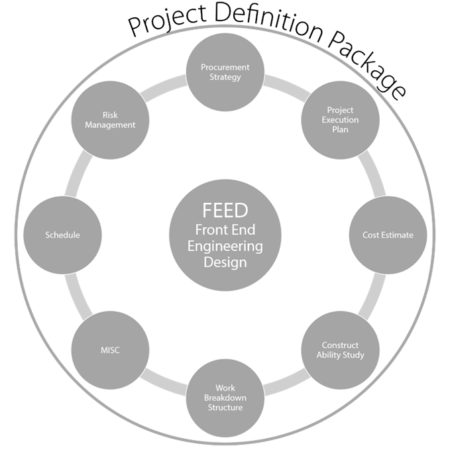
Here at Projex Solution’s, we believe a Front End Engineering Design study (FEED) is a key component for any successful project. A FEED study determines the projects scope, identifies risks, budget, and schedule; allowing a successful approach and position when arriving at the Execution Phase of a project.
This investigative phase validates technical documents, product specifications and clarifies the schedule of any project, answering those crucial questions that arise at the front end, allowing a cost effective and timely approach to any challenges or risks in those initial stages.
There are a variety of advantages to delivering a FEED study, such as:
- Reduced lifecycle costs
- Reduction of technical issues, schedule and costs associated.
- A more efficient plant/process start-up
- Mitigate any environmental, health and compliance risks.
- Improve risk identification & mitigation.
Reduced Lifecycle Costs
The FEED Study reduces lifecycle costs by developing a more efficient process by analysing existing processes and operations. Lifecycle costs are controlled by ensuring that quality equipment is used and by developing a thorough planned preventative maintenance programme providing longevity.
Reduction of Technical Issues, Schedule and Costs Associated
The FEED study reduces technical & financial issues by detailing out the design intent at the front end controlling how the project develops and providing stable, controlled platforms from the outset.
Output from the FEED study is an executed project cost estimate, developed to a level of definition agreed with you at the outset.
A More Efficient Plant/Process Start-Up
A FEED study improves a plant/process efficiency as it can analyse existing processes and operational procedures to find the most efficient and successful way to operate by incorporating new technologies, process operations & reliable maintenance regimes.
Mitigate Any Environmental, Health and Compliance Risks
A FEED study helps to mitigate any environmental, health and compliance risks as they are carefully analysed to determine the impacts of operations considered during the design phase of the project.
Improve Risk Identification and Mitigation
A FEED study improves risk identification & mitigation by reviewing the project using methods such as HAZID, basic HAZOP (from a P&ID), HAC (basic considerations). Here, we can develop the design to ensure all potential risks & operability issues fall within the relevant design criteria.
Sectors we do this in. FEED studies run across chemical, pharmaceutical, FMCG and energy projects. On low-carbon schemes in particular, the FEED is usually what a funding decision rests on. See all the sectors we work in.
How we approach it
A FEED is run by a multidisciplinary team rather than a single lead engineer. Process, mechanical, civil, structural and EC&I input is developed in parallel, so layout, utilities, control philosophy and constructability are tested against each other while the design is still cheap to move. We take the selected concept and develop it into a controlled baseline rather than starting the thinking again.
We engage suppliers early for design input and budget quotations, because long-lead items and vendor package boundaries usually drive both the programme and the cost estimate. Alongside that we identify the planning, permitting and compliance requirements that apply, including CDM duties and any DSEAR or COMAH obligations, so nothing lands late. Client workshops and technical reviews are used to agree the package, not just to present it.
We also carry out independent due diligence on FEED work prepared by others – reviewing technical documentation, verifying compliance, testing the assumptions behind the cost and programme, and reporting findings in a form a board or financier can act on.
What you get
- A design baseline: process descriptions, engineering calculations and equipment sizing
- Key drawings including PFDs, P&IDs, GA layouts and equipment lists
- Utility requirements and tie-ins covering water, power, compressed air and chemical feeds
- Preliminary specifications for major equipment, control systems and infrastructure
- A project execution strategy setting out timelines, procurement plan and construction sequencing
- A cost estimate and risk assessment, developed to a level of definition agreed with you before we start
- A register of the planning, permitting and compliance requirements attaching to the scheme
- An independent review report where we are validating a FEED package produced by a third party
When clients typically call us
- A concept has been chosen and the business needs a cost and schedule it can take to a funding decision
- Contractors need to tender against one controlled scope rather than their own interpretation of it
- Scope keeps moving between departments and nobody has a design baseline to hold it against
- A design has been inherited through an acquisition or from a third party and needs independent scrutiny
- The scheme is regulated or safety-critical, and permitting needs pinning down before commitment
- A previous project overran, and the front end is being done properly this time
Frequently asked questions
We already have a concept design – do we still need a FEED?
A concept tells you which route to take. A FEED tells you what that route will cost, how long it will take and what has to be procured. Going to tender or to a board on concept-level information is where most later rework comes from.
Can you review a FEED package someone else produced?
Yes. We provide independent due diligence for clients and investors, covering technical documentation, regulatory compliance, constructability, supply chain exposure and the credibility of the cost and programme.
How much definition does a FEED need to reach?
That depends on what the estimate has to support. We agree the depth of the study with you at the outset, based on whether you are comparing options, seeking internal sanction or going out to tender.
Does a FEED commit us to using Projex for delivery?
No. The package is written so it can be tendered to the open market. We can support bid evaluation afterwards, or continue into detailed design and EPCM delivery if that suits you better.
Related: Part of our engineering consultancy services. See also feasibility studies and EPCM partner services.
Talk to us about your project. Request a call